It is 8:30 AM. You have just finished the morning rush— Woman packing the lunch boxes, brewing that essential cup of tea or coffee, and ensuring everyone else is sorted for the day. Now, you stand in front of your wardrobe with the clock ticking. The wardrobe is full, yet you feel like you have absolutely nothing to wear.
Does this sound familiar?
For the working woman in India, dressing for the office is a unique challenge that goes far beyond just fashion. We aren’t just dressing for a meeting; we are dressing for the commute. We are dressing for the sweltering heat of May, the unpredictable downpours of July, and the freezing air-conditioning of the conference room. We need clothes that can survive a crushing ride on the Mumbai local, a dusty auto-rickshaw ride in Bangalore, or the crowded Delhi Metro, all while looking pristine when we walk into the office.
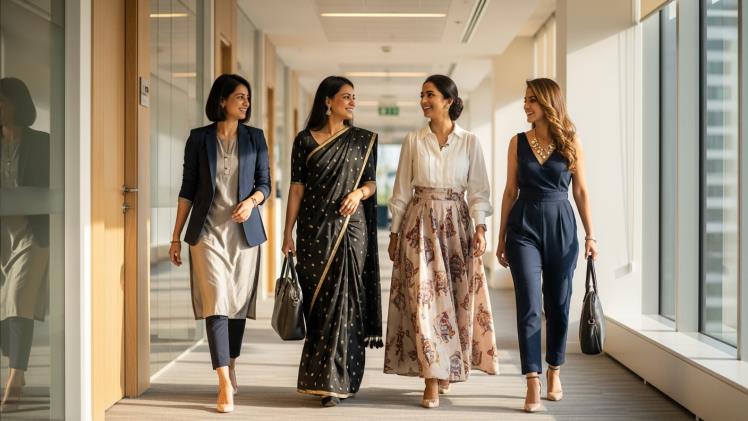
For decades, Indian workwear was synonymous with the crisp cotton saree or the starch-stiff salwar kameez. While those remain timeless classics, the modern Indian workspace has evolved. As we climb corporate ladders and navigate dynamic work environments, our wardrobes are shifting towards functionality that blends Western silhouettes with Indian sensibilities.
This isn’t about copying global trends blindly; it is about adapting them to our bodies, our weather, and our lifestyles. Let’s take a deep dive into building a work wardrobe that works as hard as you do.
The Foundation: Finding the Perfect Pair
If you look at the evolution of workwear in India over the last ten years, the biggest shift has been the move from skirts to trousers. Skirts, while elegant, can often feel impractical for the average Indian commute involving stairs, foot overbridges, and public transport. Trousers offer mobility, coverage, and a sense of power.
However, finding the right formal pants for women in India used to be a nightmare. We often dealt with cuts designed for Western body types—straight up and down—which simply didn’t account for the curvy hips and thighs that many Indian women have. We ended up with pants that gaped at the waist or pulled uncomfortably at the hips.
Thankfully, brands have started listening. The current market is full of options that cater to the “pear” and “hourglass” shapes common in our demographic. When shopping for trousers, look for high-waisted options. They are universally flattering because they cinch at the smallest part of your torso and provide a smooth line over the hips. They also ensure that when you sit down or bend over, you aren’t constantly adjusting your waistband.
The fit is everything. We are seeing a move away from the “skinny” fit that restricts blood circulation. Instead, straight-fit and wide-leg trousers are taking over. These are a godsend for the Indian summer because they allow for airflow. A wider hem balances out wider hips, creating a long, visually pleasing vertical line.
Don’t just stick to the standard black and navy blue. While those are essentials, the Indian workspace is generally more accepting of color than its Western counterparts. Dark olive, charcoal grey, chocolate brown, and even deep wine are excellent neutral alternatives that add personality to your look without breaking the dress code.
The One-and-Done Solution: The Co-ord Set
If you are not a morning person, or if your mornings are consumed by household chores, decision fatigue is real. You don’t want to spend twenty minutes standing in a towel figuring out which top matches which bottom.
This is why the rise of the formal co-ord set women are wearing everywhere is arguably the best trend to hit the corporate world recently.
A co-ord (coordinate) set takes the thinking out of dressing. It is a matching top and bottom—usually a vest and trousers, or a long tunic-style shirt with matching straight pants. It is the modern, cooler cousin of the pantsuit.
The beauty of a co-ord set in an Indian office context is its versatility. A monochrome set in deep emerald, navy, or rust looks incredibly polished. It creates a single vertical line of color, which is universally flattering and makes you look taller. You put it on, add a pair of small earrings and a watch, and you are done. You look like you put in a lot of effort, but actually, you just put on essentially what is a grown-up uniform.
Furthermore, these sets work double shifts. You can break them up. That blazer or vest from the set? Wear it with jeans on a Friday. The trousers? Pair them with a white shirt on Monday. It is a smart investment because you are buying an outfit that multiplies your wardrobe options.
Defining “Stylish” in a Corporate Setting
There is a misconception that looking professional means looking boring. We often think that to be taken seriously, we have to strip away all personality and stick to grey, black, and white. While those colors are classics for a reason, the Indian office environment is capable of handling much more character.
So, what constitutes stylish formal wear women can wear without looking out of place?
It is in the details. It is about swapping that standard, stiff collared shirt for a blouse with a cowl neck or a boat neck. It is about experimenting with sleeves—bell sleeves or cuffed sleeves can add a touch of drama without being distracting.
It is also about the “Third Piece Rule.” This is a stylist secret. If you wear a top and pants, you are dressed. If you add a third piece, you are styled. In the West, the third piece is usually a jacket. In India, given the heat, a heavy jacket isn’t always feasible. However, your third piece can be a lightweight, sleeveless long vest (often called a shrug or a gilet). It adds layers and covers the hips if you are conscious about that, but keeps your arms free and cool. Even a structured handbag or a statement watch changes the vibe of the outfit.
Navigating Fabrics and The Climate Reality
One of the biggest mistakes we make when building a work wardrobe is ignoring the fabric label. We see a beautiful top, buy it, and then realize on the first wear that it traps heat like a plastic bag.
In our climate, fabric is the most critical component of comfort. Synthetic materials that cling to the skin are a nightmare in May. While polyester is durable and doesn’t wrinkle (which is why it is so popular for workwear), it is not breathable.
Look for blends. A cotton-lycra blend or a poly-viscose blend offers the structure you need for a formal look but with enough breathability to keep you sane during the summer. Linen is beautiful but wrinkles the moment you look at it, so save pure linen for casual Fridays. Viscose and Rayon are excellent for tops as they drape beautifully and feel cool against the skin.
This is also where the concept of “office layering” comes in. You might walk from 40-degree heat outside into an office freezing at 18 degrees. You need layers that are easy to remove. Always keep a neutral-colored cardigan or a blazer on the back of your office chair. It saves you from shivering during long meetings and adds an instant layer of formality if a client walks in unexpectedly.
The Indian Context: Shoes and Maintenance
We cannot discuss office wear without talking about footwear. In many Western countries, women keep a pair of heels under their desk and commute in sneakers. In India, we often wear one pair of shoes all day.
Comfort is non-negotiable. If your feet hurt, your productivity drops. The days of suffering in six-inch pencil heels are, thankfully, fading. In Indian cities, where the pavement is often uneven or non-existent, wearing stilettos is an extreme sport.
Block heels and wedges are fantastic alternatives. They provide height and posture correction but offer much more stability on uneven pavements or tiled office floors. Loafers and pointed-toe flats are also making a huge comeback, offering a chic look without the back pain. A pointed toe is a great hack; it elongates the leg just like a heel does, but you can actually walk to the canteen or catch a cab without twisting your ankle.
Maintenance is another practical reality. We sweat, we deal with pollution, and we deal with food spills. While “Dry Clean Only” suits look great, they are high maintenance for daily wear. When building your work wardrobe, check the care labels. Aim for pieces that are machine washable. High-quality blends often retain their shape and color after a machine wash, saving you both time and money in the long run.
Confidence is the Ultimate Accessory
Finally, let’s address the mindset. For a long time, Indian women felt the need to blend in at the workplace, to be seen as “hardworking” rather than “stylish,” as if the two were mutually exclusive.
That outdated notion is fading. Taking pride in your appearance is a form of self-respect. It signals to your colleagues and clients that you pay attention to detail. Whether you are rocking a pair of sharp trousers or a fusion set, the goal is to feel powerful.
When you walk into a boardroom, you shouldn’t be worrying about your waistband digging in or your shirt gaping. Your clothes should be a second skin—armor that protects you and projects your competence.
So, next time you go shopping, don’t just buy what’s on the mannequin. Try things on. Sit down in them. Walk around the store. Look for those cuts that let you breathe, hunt for those trousers that hug your curves just right, and build a wardrobe that makes that 8:30 AM rush just a little bit easier. Because when you look the part, you are already halfway to owning the room.